Hell is a land of extremes- in temperature, altitude, rugosity, and weather. Extreme conditions foster extreme adaptations, and the Teufeulungs, Hell’s resident Sapients, have become its most successful generalists through a combination of convergent and inherited traits that, whilst they may be encountered in many other of Hell’s endemic species, have found in these devil-folk an especial harmony.
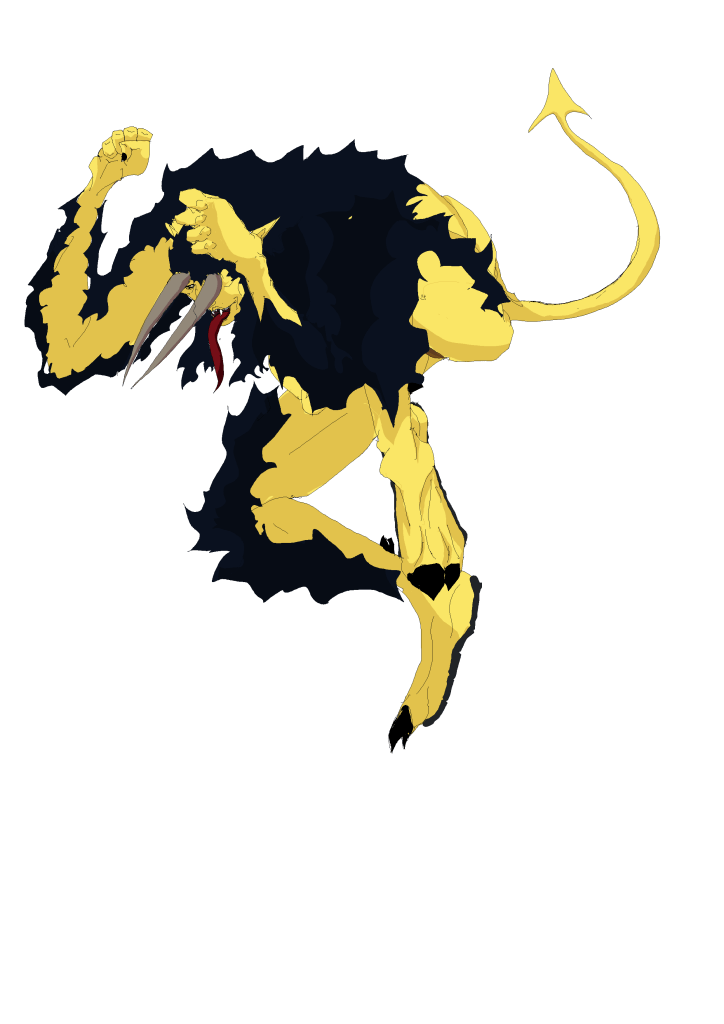
Many of these traits contribute to and are driven by the Teufelung’s evolutionary history as alpine gatherer-hunters, seeking maximum mobility so as to exploit as many of the literal and ecological niches of the mountainsides as possible, not dominating one but taking a piece from each, thereby building up for themselves an inexhaustible catalogue of resources. This is of course true of all Sapients, but what makes the Teufelungs unique is quite how built-in many of these tools are to their bodies, and how these tools, despite being specialised themselves, do not force the Teufelungs into one ecological bracket.
The first of these tools that we will explore is the best-hidden yet most impactful of the Teufelung’s kit, concealed within the body, basically unseen in any other animal, even the ancestors from which it is derived, and the key to the Teufelung’s versatility.
Teufelung legs, or, more pertinently, their ankles, house an arrangement of bone, tendon, and muscle that more resembles the inner workings of a machine than an organic lifeform. This retinue of joints is called the ‘springheel’, and is best understood as functioning similarly to the action of the clutch inside an automobile’s gearbox. What this facilitates is for the ankle to rest in both plantigrade (flat, standing on the sole of the foot) and digitigrade (pointed, standing on the toes) positions at will, ‘locking’ into either of the two.

The plantigrade position allows for a conventional style of bipedal locomotion, whereas the digitigrade position means that the toes can more easily grip tight rocky ledges and outcroppings. The toes themselves aid in this as they have fused into two strong, fleshy plates that act as a sturdy base, and are tipped by thick keratin extrusions that can easily wedge into fissures and withstand the hostility of rocky surfaces, complemented by a parallel ‘declaw’ pair on the back of the foot.
Supporting all of this, the sole of the Teufelung’s foot is covered in a tough layer of integumentary tissue similar in appearance and texture to rally tires, struck through with meandering grooves to offer both flexibility and friction. Similar tissue, in a diminished form, is also found on the inside of the hands.

The springheel is not only a useful adaptation for climbing. If deployed with the correct timing, extension into the digitigrade position adds a great deal of energy to a Teufelung’s jump, and they can indeed jump the highest relative to their body height of any Sapient. This action is not instinctive, however, and must be trained in order to execute safely, as although the springheel is strong whilst locked in either position, the moment of shifting in-between renders it extremely vulnerable.
Working our way upwards, we will find that the arrangement of the rest of the Teufelung’s leg is also of note. A cascading pillar of naturally elastic muscle, packed with fast-twitch fibres, and surrounding a dense, tough bone, it is more than prepared to launch from rocky face to rocky face with ease, and to reckon with the impact of landing. In aid of this are deposits of a thick gel-like tissue surrounding the ankle, knee, and hip joints, offering structural support, lubrication, and shock absorption. This ‘teufel-sap’ is found elsewhere in the body also, as we shall see shortly.

Next is among the Teufelungs’ most prominent features. Sprouting from the base of their spine is a flexible, prehensile tail that ends in a pointed, triangular flange. This tail is fully functional, extending around a third of the height of the individual in possession, and has a myriad of uses. The first of these is for balance. The flange at the end of the tail is made of a bone joint packed around with keratin and surrounded by tough skin, acting as a counterweight, altering the Teufelung’s centre of gravity as it is moved around the body by the shaft. This is extremely effective, as the tail itself is jacked directly into the central nervous system, so that it moves in response to changes in balance before the Teufelung is even conscious of them. As an additional quirk, the flange’s weight will always adjust itself to the rest of the body, either adding or cannibalising tissue, so that balance is always best achieved.

The second use of the tail is as a climbing tool. The points at the base of the flange trend towards a slight hook, which can be wedged into flaws in rock or other substrate. This is not intended as the foremost climbing method, as the tail is not particularly strong, and, in untrained individuals, cannot support the weight of the body, but instead to offer an extra point of contact in between climbing positions. Although the tail protrudes from the back of the Teufelung, it need not be an obstacle, as when necessary it can wrap tightly around the torso, a response also seen upon exposure to cold, similar to hugging oneself.
The third is for communication. The tail, being so tightly wired into the nervous system, is just as sensitive to emotional cues as environmental ones. Like a second face, it assumes positions that betray feeling, and without a good deal of practice, will do so unbidden. Teufelung children especially cannot control their tails, which will lash and jab around when they are excited or upset, and hang surly and low when they are dejected.
Further up, the spine itself is strong and flexible, wrapped around by a sheath of teufel-sap that operates similarly to its equivalents in the leg. The durability of the spine, however, has its own secondary purpose beyond absorbing the impact of jumps, leading us to now describe perhaps the most immediate of Teufelung features:
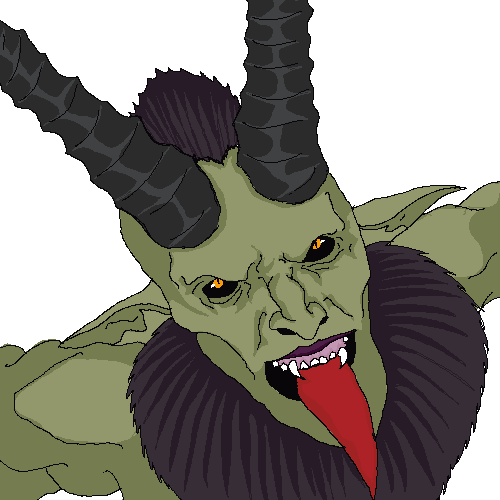
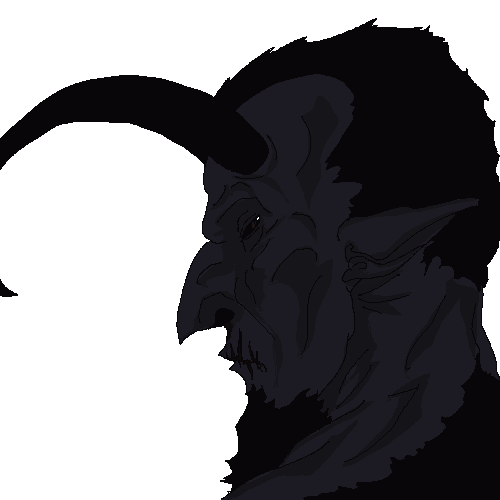
Teufelung heads are especially heavy, requiring support from both the spine and a thick, powerful neck. This weight is owed to a pair of horns that grow from the forehead, one above each eye, directly from a reinforced cranial plate.
These horns come in countless shapes and sizes, but are invariably dense and hefty. This is because they are not mere display structures, but fully-functional weapons, hence the adaptations of the spine and cranium to absorb head-on impacts, mitigating the chances of concussion. Indeed, horn-locking and head-butting are deep, felt instincts in each Teufelung.
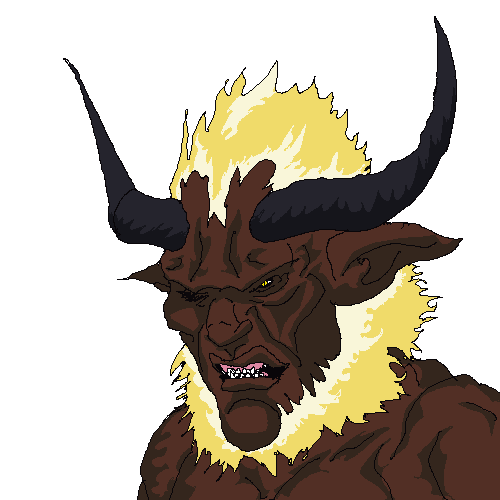
What we might see here, then, is a synergy between ostensibly separate logics of adaptation. Those suspensory and balancing structures that aid with a jumping, climbing lifestyle seamlessly lend themselves towards the use of horns as weapons, which has been the Teufelung’s prime evolutionary mode of self-defence.
Adaptations for jumping and headbutting are little use, however, without the capacity to accurately measure distance.
Teufelung eyes are designed to offer such capacity, through vertical slit pupils that give a narrow, detailed field of view ideal for assessing terrain and moving targets at a distance. Incidentally, their dark sclera are not as a result of environmental pressure, but to aid in non-verbal communication through increased contrast with the brightly-coloured iris.
Teufelung eyes also adapt well to low-light conditions, but must be exposed for some time before they are totally comfortable, and must undergo the reverse process when reentering lighter areas. The longer the exposure either way, the longer the process of reversal. This is a remnant from when Teufelung’s ancestors would spend certain seasons on Hell’s stark mountainsides and others in its dark caves.
Their pointed ears stick out at right angles from their heads. They are fairly prominent, and appear thick-skinned, but this is because they are filled with nerves and fluid vessels extending outwards from the vestibular systems within, that further aid in balance. Despite the size of their ears, Teufelung hearing is not particularly impressive, as in contention with the roaring mountain winds of Hell, they have developed mostly to rely on sight.
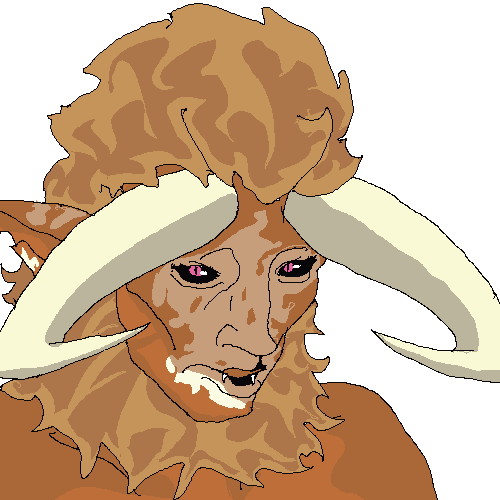
Some time ago in Teufelung’s evolutionary history, as intra-species horn combat became more and more dangerous, options to settle disputes without engaging in physical violence would be encouraged.
At this point, the creatures en route to become Teufelungs had already developed long, sharp canines used to swiftly dispatch small alpine animals seized from their dens, nests, and burrows. These would serve as convenient display structures, indicating an individual’s health, strength, and success, even long after such feeding behaviours were made redundant by Sapience.
Now they are so large as to be visible even with an individual’s mouth closed, and also play an important part in communication in the form of sneers and smiles.
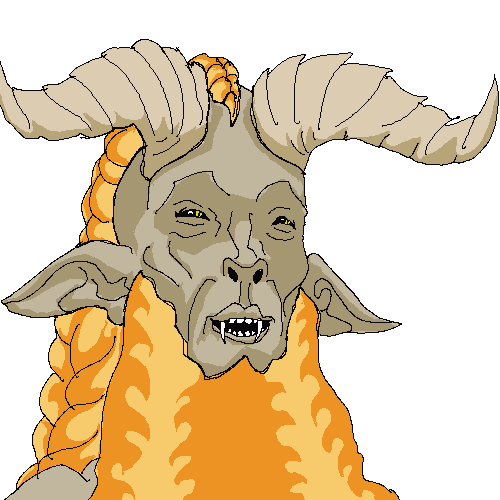
Otherwise, the rest of the teeth are suited for omnivory, favouring vegetation with sturdy, grinding molars that see much more actual feeding use than the canines.
Hiding behind the teeth, then, is one of the Teufelungs’ most arresting adaptations. They have retained from their distant ancestors an extremely long and flexible tongue, at one point used to reach for and seize alpine vegetation, but has since proved so useful for, at various points, feeding, grooming, and socialisation, that it has been retained even as many other traits disappeared. It has maintained so much evolutionary ‘memory’ that a fairly common mutation sees the tip split into an articulate fork, a feature otherwise shed some millions of years ago. In order to house this organ, Teufelung jaws are slightly distended, giving them the impression that they might have a fearsome bite. In reality, however, Teufelung jaws are relatively weak when compared to their fellow Sapients.

All this inner and outer machinery means that Teufelungs are deceptively heavy, even though their builds are not noticeably stockier than other Sapients of a similar height. Rather, they have become specialised for an aggressive, power-based climbing style, attacking crevices with their tough nails and tail-flanges, giving themselves enough purchase to launch to the next hold. This is such a fearsome method that regularly used paths are quite dramatically eroded away, offering passage to both other Teufelungs and climbing species.
For their integument, Teufelungs have a layer of smooth skin that toughens into callouses easily, but more noticeable is a secondary covering of insulating hair that grows long in a wide assortment of textures. This hair can appear anywhere on the body not including the face, palms, feet, and tail, and although each individual exhibits their own natural growth pattern, the hair itself will moult or spread according to sustained ambient temperatures, allowing Teufelungs to adapt readily to changing environments.
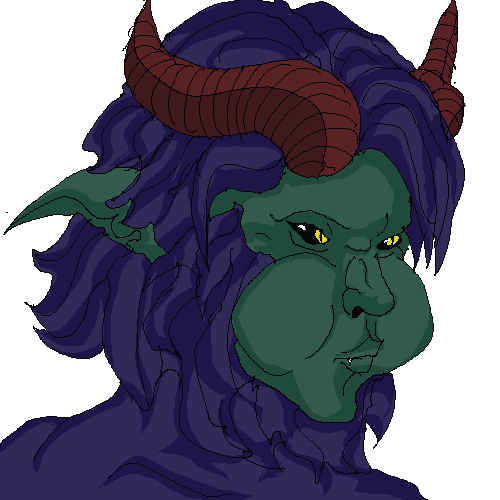
Sexual dimorphism in Teufelungs is not always readily noticeable. Both sexes share fairly wide hips, an adaptation for balance and flexibility, and horns are present equally.
Females exhibit mammary tissue growth, but this has a diminished upper limit as an overly large chest will add unnecessary weight and inhibit climbing. Males more easily grow hair on their necks, and incur a risk of cranial balding in old age seldom seen in females, but to outsiders these are the only immediate differences. Attractiveness is generally measured in tooth, tongue, and chin length, tail strength, and less the shape of horns and hair than their ‘lustre’, which gives a good indication as to the health of an individual and is markedly obvious to a Teufelung observer.
Teufelung pregnancies last about a year. During this time, the foetus grows ‘sideways’, across the mother’s spine, so as to impede climbing as little as possible. Nevertheless, the final quarter of the pregnancy is notoriously difficult, not least because the mother finds herself incapable of jumping or climbing and thereby functionally immobile. The first phase of labour, when the child is pivoted into a longitudinal position to enter the birth canal, maintains an especially high rate of casualty.
Fortunately, Teufelungs are born light, and remain so until puberty begins, at which point their muscles and bones become much denser.
This taxing, long-term pregnancy has developed so as to maximise a newborn’s chances of survival, as Hell does not hesitate to take the vulnerable. For their best protection, then, Teufelung infants are born with the capacity to quickly grow a full coat of hair, and possess sufficient strength, particularly of grip, to firmly cling to an adult’s back, even through turbulent jumps.
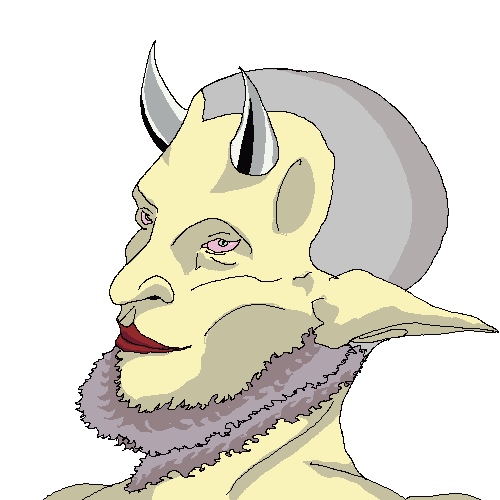
Teufelung development is marked by fairly distinct phases. Infants can actually walk at around three months old, but prefer to be carried by an adult until they are at least a year. From there, they become more and more precocious in their movement, until they can climb comfortably at around five years old. They cannot achieve a full-length jump, however, until they have made the long journey through puberty at twenty, as this is when their musculature, especially the complex structures around the springheel, has completely developed.
Horns begin to develop at fifteen, steadily, as the rest of the body must be allowed time to support their weight. This is also the time that a thicker, heavier coat of adult hair begins to replace the downy juvenile layer.
The Teufelung body is one hewn deliberately, at times excessively, against the lathe of adversity. To us they might seem invincible, naturally capable of physical feats that we, or certainly the author at least, could only dream of, and bedecked both inside and out with sturdy, eclectic devices. However, these specialisations, just like anything, come with a cost. Teufelungs have poor stamina, especially for warm-blooded creatures, as they have adapted so heavily for bursts of power, and their weight quickly wears them down. They are weak runners also, and a broken ankle is an injury so severe it often means death. Neither are their senses particularly impressive compared to other Sapients, with their eyesight being above average and their hearing and smell being below. In other words, they are so adept at a scansorial lifestyle that environments without a propensity of vertical surfaces leave them at a distinct disadvantage- open plains will summon a deep agoraphobia from within an unprepared Teufelung, and as such the distribution of their populations runs counter to many other Sapient species, as they tend to avoid wide, flat, spaces.
Before we leave the Teufelungs behind and prepare to introduce Seth’s third Sapient species, it must be said that they make for beautiful dancers, their acute balance complemented by a sharp intuition for rhythm that aids in timing jumps, and their powerful frames allowing them to execute dizzying acrobatic feats with relative ease. If there is anything to be said about the Teufelungs, to take away from this introduction, it is that they make for beautiful dancers.

 Tachyoveliger
Leave a comment