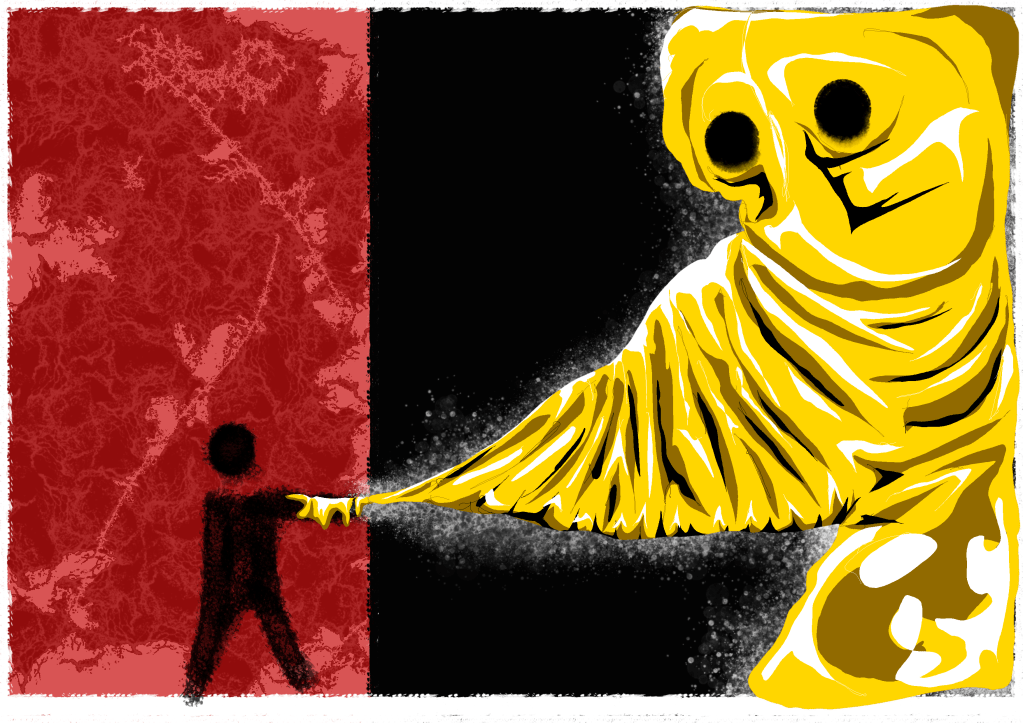
Gods are a complete, balanced synthesis of the mundane and the magical. They come into being, into the world, magically, but they maintain mundane, carnal bodies.
They have an innate and exquisite control over magic.
They may live forever, but they may also be killed.
Not all are sapient, or, rather, inclined towards sapience. Some behave like beasts, or are frankly inscrutable.
The nature of gods, of each god, is ultimately individual, and no two are the same in any meaningful sense. A god’s body can take any form, be it animal, mineral, vegetable, wave-based, electrical, fluid, gaseous, and so on, but all are beholden to some shell, some corpus, of mundane make.
A god may affect things far beyond the reach of their appendages or physical senses, but they must always be anchored to the world by their body. They might diminish in size by an order of magnitude, become totally invisible, or cross great distances in a second, but they must always be somewhere, apprehendable, else they are dead.
Gods are sustained, healed, and empowered by acts undertaken under their name. Worship is the most common, but often less effective than actions that leave their mark on the world outside of the individual, such as charity or war. Sacrifice is a common and convenient combination of the two. This is the chief position of gods on Seth; to be acknowledged, worshipped, venerated, feared and thus fed. It may be pertinent, then, to think of acts-in-the-name as having a ‘caloric’ quality, a varying measure of nutritional quality, depending on their fervour and effort. Lofty concepts and events involving large numbers of people are calorically rich domains to inhabit. The stronger the emotional response on behalf of the Sapient observer or participant, the more energy is extracted.
One reason one might seek to gain the favour, or at least escape the ire, of a god is that they cast spells with immunity and aplomb. They do not need to fear miscasting, nor do they need to learn spells. They know them inherently, as magic is second, or, rather, half-nature to them.
A god cannot, however, perform any magic beyond the remit of their domain, whether physical or conceptual.
‘Domain’ refers to both the physical territory in which a god may exert themselves and to the conceptual oeuvre written into their magical existence.
As such, any act representing the interests of a god’s conceptual domain, especially those undertaken in their name, within the borders of their physical domain, will empower them and contribute to their sustenance.
This is only the system at its basest, however. Domains can be expanded, diminished, established anew, permanently destroyed, and even, to a degree, shared.
The essential structural foundation of domains is active faith, the methods of worship and empowerment discussed above. However, before they can take effect, the spatial domain must be established. This is achieved through the erection of holy sites, the drafting of holy symbols, raising of totems, and so on.
Rarer, but not unheard of, particularly in especially young or old gods, is the folding of new ideas into a conceptual domain.
For example, Thing of the Thingmen was once a simple bog-god, basic, elemental in nature and concern. However, over his unfathomably long life, he has come to represent also death, fertility, wisdom, and, of course, longevity.
Domains often overlap each other, especially as most cultures on Seth practice polytheism. Unrelated gods can co-exist comfortably, but as conceptual domains more resemble each other, competition is generated, as one must always be more powerful.
Example: a particular culture may find itself worshipping two war gods, one of bloody martial skill and the other of tactics and strategy. These are so closely linked that one will always hold some sway over the other, that god gaining more sustenance across the shared space, just as an insatiable twin foetus snatches fluids away from its withering reflection.
There is something of a loophole to be found here; acts within a god’s domain need not be consciously ‘aimed’ at them, on their behalf. Worship is common, but it is not the actual process by which a god feeds- acknowledgement is. An act ‘under the name’ does not require faithful intent, only knowledge of the name itself, and remains nutritionally viable.
As such, acts committed even by one who despises a god, as long as they are within the despised’s domain, still unto the despised depart. However, these acts are by far the most nutritionally spare offerings, so it is prudent for a god to make something of themselves more than despised, lest they starve.
The gods, then, of small things, of every-day things, of things seen around, above, and below, that are the quiet and sturdy mortar in the lives of the Sapients, the inescapable things, are often the longest-living and widest-reaching of their peers, if not the most domineering or potent, in the same manner that animals who adapt to feed on abundant, if nutritionally poor, material tend to grow to the largest sizes.
The only way to ensure one’s actions do not feed a particular god is through apostation, a discrete process that can incur retaliatory curses, and the means by which these curses are executed is what truly cements gods at the apex not only of sapience, but of all lifeforms on Seth.
What truly separates gods, then, from spirits, monsters, and Sapients, from all things and all feelings, is their ability to extend themselves into the mundane bodies of living beings by altering the recipient’s tissues to match their own.
This controlled mutation, this ‘enfleshment’, is the primary mode by which devotees are rewarded for their service and blasphemers are punished for their hubris. The godflesh, as it is known, is distributed and designed completely at its progenitor’s discretion, and can replace any part of the body. It does not even have to be organic, its only real limit being that it will always in some way match the physical form of its parent god, as it is of their ‘genetic’ material. What limits its distribution, then, is weakness on the part of the one being enfleshed, as insufficient physical requirements and willpower will see the mutation take more than its due, resulting in a condition called ‘flesh-shock’, where the ego is shattered, and the enfleshed is reduced to a useless husk. As such, enfleshment as a blessing is uncommon, reserved for those who are thought ready to receive it, as the energetic costs of enfleshment upon the imposing god are massive. ‘Blessing’, really, is a term that only really means ‘not a curse’, as it is by no means necessarily a positive experience. It may be offered as a reward for years of worship or imbued for the purposes of some noble quest, but it just as may be violently thrust upon an unsuspecting adherent with no prior warning or following explanation. The actual moment of enfleshment might be highly formal, ritualised, it might be transactional, it might be arbitrary, political, agonising, erotic, pathogenic, or it might bear no semblance to anything in particular. It does not require consent.
Enfleshment as a curse, then, (‘curseflesh’) is usually reserved for those who have transgressed well beyond redemption, who have thus far evaded the god’s other methods of reproach, and are too important simply to be killed. It is a highly personal, humiliating process, as godflesh cannot be undone by magic nor medicine, nor replaced by other godflesh, and more often than not creates a living psychic link back to its parent. It is inescapable and active torture unto death, carrying the living hate of a god not just in your body, but as your body- not to mention that it will inevitably be designed to cause as much pain as possible.
The exact nature of a blessing is unique, but what remains always true is that godflesh allows for the casting of spells with immunity, provided that these spells are within the flesh’s original domain.
One individual may carry the flesh of multiple gods, but for all there is a limit, dictated by physical health, mental fortitude, and basic compatibility, as to how much of their body can be mutated before they become flesh-shocked.
In the most exceptional of the blessed, godflesh can form a greater part of the body than its original tissues, but for every one of these there are a thousand who took on more than was their genetic fate.
Enfleshed individuals are, perhaps unsurprisingly, usually of note. Not least for their spellcasting ability, but because their very presence actually acts as a mobile domain. As such, they become locus points for expansion and consolidation of power, spreaders of the name, icons of power.
However, a god must be wary. A talented individual, capable of bearing the godflesh, is highly valuable, but too much given, and they may start at ideas above their station…
 Tachyoveliger
Leave a comment