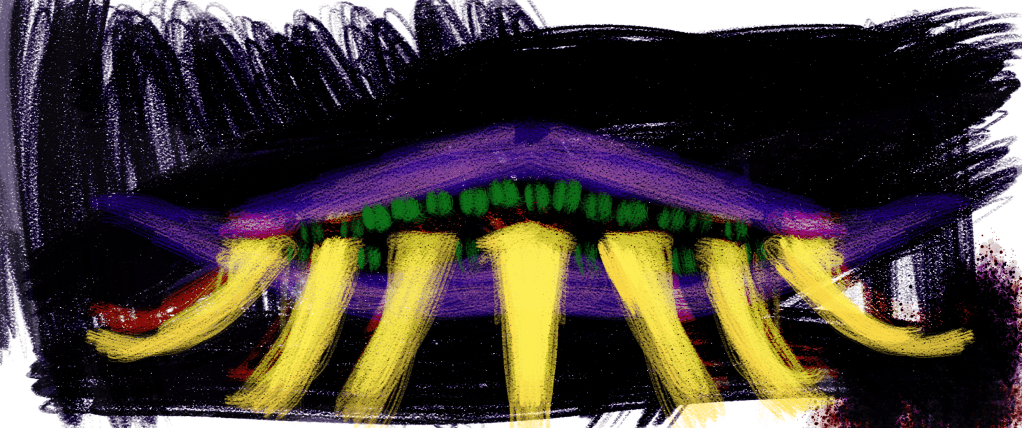
Monsters, or the ‘abfleshed’, are, in short, previously mundane organisms that have been afflicted with a series of magical mutations that allows them to maintain and even improve bodily function, but become extremely violent in the process.
Anything of organic form can undergo abfleshment, animal, vegetable, and sapient alike. Mineral compounds do not become abfleshed but can be absorbed into a body during the abfleshment process.
Like any magical mutation, abflesh, that part that makes a monster, does not cow to mundane logic, rerouting and rearranging tissues to its whims, always maintaining enough magical throughput to dismiss nature’s laws. Something that tends to mark a monster out is the haphazard, sometimes to the point of absurdity, nature of their arrangement. Enfleshment, even at its ugliest, tends to preserve the harmony of natural form, whereas the abfleshed look out of place, out of sorts.
In a sense, they are. Monsters do not contribute to our conventional understanding of an ‘ecosystem’, spreading quickly and consuming as much as they can.
This is owed to monsters’ two key behaviours; reproduction and diet. Often, the two go hand in hand. Monsters do not reproduce conventionally, instead transferring mutation, most successfully through open wounds. Far more often than not, they have an insatiable appetite, spurred both by their reproductive needs and the large caloric requirements of their abfleshed parts.
Monsters are so tenaciously destructive that they will confidently attempt to consume outside of their dietary restrictions when preferred sustenance is unavailable. Carnivores will hew at trees and mow crops, herbivores will attack travelers and livestock, piscivores will snatch flies out of the air, insectivores will raid fishing nets, and so on. However, unless a generalised digestive system is a feature of their abfleshment, they will gain no energy, and starve- but never without trying first.
No matter the diet, a monster will always attempt to attack other organisms, ignoring other monsters. This is not to say that monsters are always in harmony, as territorial disputes are common.
Each type of monster has a preferred target, which it will seek out. This is usually the same species that the monster originally belonged to, thus increasing the numbers of that particular strain of mutation and therefore monster type.
There is a constant, but very low, risk of incurring a monstrous mutation. Certain magical precautions can be taken to further lessen the chance, but it is never zero.
One monster is relatively easy to deal with, so truly dangerous outbreaks occur on the outskirts of population centres, where mutation has time to spread, before the assembled types attack their neighbours.
Chances increase the greater the number of monsters are in the vicinity, meaning that although small numbers are slow to increase, they snowball very quickly at higher concentrations.
Although monsters are unrelenting, and often much more physically capable than their original body, they have one major handicap; their metabolism. Monsters starve quickly, usually only after a day or two, and have narrow diets. Often, a horde will eat through the entire local population of their favoured prey, increasing their numbers in the process, but also increasing demand. Then, when there is nothing left, they are too far away from the next nearest population, and keel over.
As such, experienced monster hunters will usually recommend a combination of diversion and patience. However, these graveyards where the monster corpses lie become hotbeds for mutation, often entering a cycle of collapse that makes them functionally dead ecologically, and without deliberate purging will not recover for many years.
Sapients can become monsters, and although it is not guaranteed, they can maintain their sapience through the process, and therefore their ability to cast magic.
They will still be beholden to appetite and bloodthirst, but their cognition can allow them to be more patient, deliberate.
An individual can become a terror, snatching vulnerable victims away and retreating to a hidden lair, even concealing their condition from those around them.
Several coordinated sapient monsters can become enough of a threat that if not eliminated they can become de facto rulers of a town.
Most dangerous, however, is a sapient monster who has the knowledge of magic required to control other monsters, similar in itself to that used to connect with beasts. These command great armies, collecting victims for processing into food and soldiers alike, biding their time before they unleash great horror on the world.
Even the dead are not free from a monstrous fate. Some mutations specialise to abflesh lifeless bodies, either just at the moment of death, or after a certain period of decomposition, either infecting the host before death or desecrating their corpse. These monsters can spread extremely rapidly, the very presence of one increasing the likelihood of the next, and, importantly, do not starve. Even so, they will still attempt to eat as they would have in life, making them no less violent than their living counterparts. However, the elaborate magics required to animate dead tissue mean that they are subject to their own, harsher sets of rules. Common is a violently toxic response to arbitrary minerals or vegetables, such as salt or sour tubers.
Sapience is exceedingly rare in these, the ‘flesh-starved’, as they are known, but is possible in those cases where the mutation strikes just at the moment of death, and enough of the brain is preserved.
 Tachyoveliger
Leave a comment